Drip Dropper
Deformation-sensitive liquid handling
Transfer liquid and return the dropper to its bottle.
Dropper placement is randomized.
Video coming soonAnonymous submission · Under double-blind review
Spatiotemporal Tactile Grounding for Adaptive Directional Compliance in Contact-Rich Manipulation
Anonymous authors · Affiliations withheld for double-blind review
Vision-Language-Action (VLA) policies specify desired motion, but contact-rich manipulation also requires deciding how strongly the robot should resist or yield as physical constraints evolve. We present CoFlex-VTLA, a framework for jointly predicting reference motion and task-conditioned asymmetric directional compliance from visual, language, robot-state, and tactile context. Its Asymmetric Directional Compliance Field (ADCF) assigns separate translational stiffness values to opposite displacement polarities along each Cartesian axis. To condition this mechanical response on the evolving interaction, a spatiotemporal tactile encoder combines distributed contact measurements with multi-rate history; a high-rate compliant controller executes the paired motion–compliance commands. Across four real-world manipulation tasks, CoFlex-VTLA achieves a mean success rate of 72.5%, exceeding the strongest evaluated baseline by 6.25 percentage points. Component ablations support explicit compliance prediction and tactile history. Force–stiffness trajectories illustrate the predicted directional responses, while liquid-mass measurements provide complementary evidence of physical outcome consistency.
CoFlex-VTLA jointly specifies where to move and how strongly to resist or yield. Spatiotemporal tactile context grounds reference-motion and compliance prediction in the evolving physical interaction.
Spatial encoding and multi-rate history
Bidirectional cross-attention
Paired reference-action chunks
Six polarity-dependent stiffness values
High-rate reference adaptation
Contact-conditioned physical execution
HiST-TM models spatial correlations within each tactile frame using GATv2. A 128-frame tactile context supplies multi-rate historical sequences, which are integrated by two-stage S4D encoding. This history modulates the current tactile representation before bidirectional cross-attention fuses it with the VLA context.
ADCF assigns independent translational stiffness values to the positive and negative displacement polarities of each Cartesian axis:
The displacement from the reference selects the stiffness for each axis. Rotational motion and gripper commands remain part of the reference action. Interaction-phase targets supervise the compliance branch during training; inference requires no phase labels or online stiffness tuning.
At 200 Hz, fingertip measurements are aggregated into a Cartesian contact-force estimate that adapts the nominal reference:
For the same force error, compliant directions receive larger reference corrections. A Cartesian stiffness–damping controller realizes the predicted mechanical response between policy updates.
Four laboratory tasks probe deformation-sensitive liquid handling, constrained extraction, insertion, and sustained surface contact. A trial succeeds only when the complete task criterion is met.
Deformation-sensitive liquid handling
Transfer liquid and return the dropper to its bottle.
Dropper placement is randomized.
Video coming soonConstrained extraction and transport
Extract the stopper and place it in a basket.
Stopper tightness and orientation, and bottle position, are randomized.
Video coming soonLoad-bearing transfer and insertion
Transfer the test tube into the target rack.
Test-tube and rack positions are randomized.
Video coming soonSustained surface contact
Remove the stains from the watch glass.
Stain patterns are randomized.
Video coming soonAll methods use the same demonstrations and training epochs, with their respective observation settings. The training corpus contains 200 demonstrations for each of six tasks (527K frames); the current evaluation reports the four tasks above. Visual observations and demonstrations run at 30 Hz.
CoFlex-VTLA achieves 72.5% mean task success, exceeding RDP by 6.25 pp. The advantage is concentrated in liquid handling and stopper manipulation; RDP retains the highest insertion and cleaning success counts. CoFlex-VTLA lifts every test tube but completes insertion in 12 of 20 trials, identifying constrained placement as a remaining bottleneck.
Each method is evaluated in 20 full-task trials per task. The final column of each task records complete-task success; drip/return includes returning the dropper. Avg. is the unweighted mean of the four complete-task rates. Percentage-point differences use unrounded rates. Highlighted cells mark column-wise maxima, including ties.
| Policy | Drip Dropper | Remove Stopper | Replace Test Tube | Clean Watch Glass | Avg. (%) | |||||
|---|---|---|---|---|---|---|---|---|---|---|
| grasp | suck | drip/return | remove | put | lift | insert | take | clean | ||
| Without tactile input | ||||||||||
| DP | 12/20 | 5/20 | 0/20 | 16/20 | 16/20 | 8/20 | 0/20 | 15/20 | 5/20 | 26.3 |
| π0.5 | 18/20 | 12/20 | 2/20 | 14/20 | 10/20 | 11/20 | 1/20 | 17/20 | 11/20 | 30.0 |
| WALL-X | 20/20 | 15/20 | 3/20 | 16/20 | 14/20 | 13/20 | 1/20 | 19/20 | 15/20 | 41.3 |
| With tactile input | ||||||||||
| ACP | 5/20 | 2/20 | 0/20 | 13/20 | 9/20 | 17/20 | 5/20 | 14/20 | 12/20 | 32.5 |
| π0.5+tac. | 3/20 | 0/20 | 0/20 | 7/20 | 5/20 | 2/20 | 0/20 | 12/20 | 0/20 | 6.3 |
| RDP | 17/20 | 14/20 | 5/20 | 19/20 | 19/20 | 15/20 | 13/20 | 19/20 | 16/20 | 66.3 |
| CoFlex-VTLA | 19/20 | 15/20 | 11/20 | 20/20 | 20/20 | 20/20 | 12/20 | 18/20 | 15/20 | 72.5 |
Successful grasping alone does not ensure liquid transfer or completion of a contact-rich task. Direct tactile concatenation also underperforms its tactile-free backbone in this evaluation, motivating structured use of physical feedback. The component comparisons below examine compliance and tactile history within CoFlex-VTLA.
An electronic balance measures liquid mass over five trials per method. The reference interval, [1.2, 2.8] g, comes from liquid-mass increments during uptake in the demonstrations. Mean and population SD use all five measurements (SD denominator n = 5). In Range gives the percentage and count within the interval.
| Policy | Mean ± SD (g) | In Range |
|---|---|---|
| DP | 0.0 ± 0.0 | 0% (0/5) |
| π0.5 | 0.3 ± 0.6 | 20% (1/5) |
| WALL-X | 0.9 ± 1.0 | 40% (2/5) |
| ACP | 1.2 ± 1.0 | 60% (3/5) |
| π0.5+tac. | 0.0 ± 0.0 | 0% (0/5) |
| RDP | 1.6 ± 1.3 | 60% (3/5) |
| CoFlex-VTLA | 1.9 ± 0.8 | 80% (4/5) |
CoFlex-VTLA places 4/5 measurements within the reference interval, compared with 3/5 for ACP and RDP. Its reported 1.9 ± 0.8 g indicates less variation than these two baselines. A zero mean and spread do not indicate successful regulation when the required amount is nonzero. This five-trial physical-outcome evaluation complements the complete-task criterion, which also requires returning the dropper.
Ablations evaluate test-tube insertion and stopper removal with 20 trials each. Avg. is the mean of the two stage success rates; full-model results are shared with the main evaluation. Symmetric compliance averages the two predicted stiffness polarities on each axis. Fixed compliance uses the midpoint of the task's demonstration stiffness bounds.
| Variant | Test-Tube Insertion | Stopper Removal | Avg. (%) |
|---|---|---|---|
| CoFlex-VTLA | 12/20 | 20/20 | 80.0 |
| Sym. Compliance | 6/20 | 20/20 | 65.0 |
| Fixed Compliance | 6/20 | 18/20 | 60.0 |
| No Compliance | 1/20 | 10/20 | 27.5 |
| Single-Rate History | 5/20 | 16/20 | 52.5 |
| Current Tactile Only | 3/20 | 9/20 | 30.0 |
The full model reaches 80.0% across these two stages. Its 15.0 pp advantage over symmetric compliance comes entirely from insertion; both variants succeed in every removal trial. Tactile history benefits both stages: the full model exceeds single-rate history by 27.5 pp and current tactile input alone by 50.0 pp. These comparisons support conditioning motion and compliance on the preceding interaction; they do not separately isolate spatial encoding.
The stiffness traces show how mechanical responses vary with interaction progress, axis, and displacement polarity. During stopper removal, positive z-axis stiffness decreases while the opposite polarity remains comparatively high. During cleaning, the two x-axis polarities separate under sustained contact, while the displayed z-axis stiffness remains relatively stable.
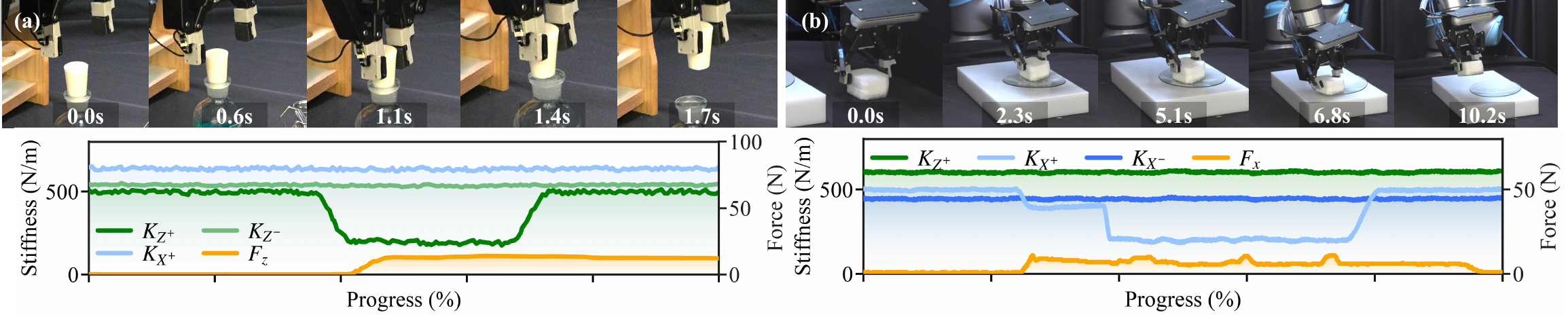
Test-tube force profiles provide a complementary view of contact evolution across pickup, transfer, insertion, and release. Qualitative agreement with a reference trace does not independently establish insertion reliability: CoFlex-VTLA remains one successful insertion below RDP.
Representative failures involve unsuccessful liquid uptake, premature liquid release, loss of stopper retention, and incomplete cleaning. Each violates a physical requirement that reaching the nominal pose alone does not guarantee. Selected examples characterize failure modes, without establishing their frequencies or attributing them to a single component.
Citation details will be available after double-blind review.